Mercury

Mercury |
|
|
| Home | Stars | Orbits | Habitability | Life | | |||
| | System Summary | Rocky Inner Planets | Main Asteroid Belt | Gas Giants | E-K Belt & Dust Disk | Oort Cloud | | |||
| | Sol | Mercury | Venus | Earth | Mars | Jupiter | Saturn | Uranus | Neptune | Dwarf Planets | Sol b? | |
Breaking News
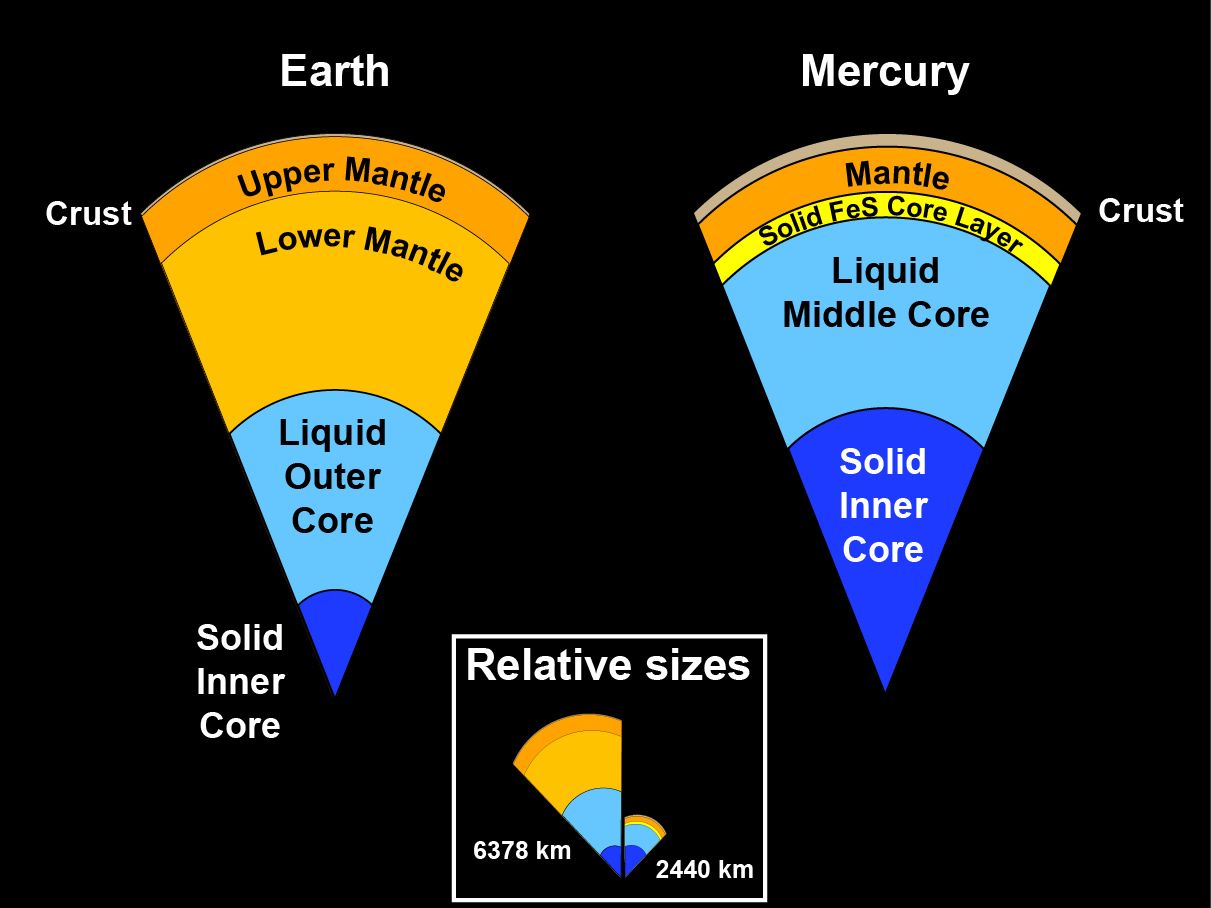
On March 21, 2012, the NASA's MESSENGER mission team revealed that Mercury has the Solar System's largest known core relative to the planet’s size. Extending to about 85 percent of the planetary radius, this core larger than previous estimates. Subtle dynamical motions measured by Earth-based radar, the observed parameters of its gravity field, and observations of the magnetic field indicate that Mercury’s core is at least partially liquid with an active core dynamo. The core also appears to be surrounded by a relatively thin, hard shell of Iron Sulfide, underneath another relatively thin silicate mantle somewhat similar to Earth's (NASA MESSENGER press release and featured image; Smith et al, 2012; Mike Wall, MSNBC News, March 21, 2012; and Paul Rincon, BBC News, March 21, 2012).
 MESSENGER,
CWRU.
NASA
MESSENGER,
CWRU.
NASA
Larger and
jumbo illustrations.
Mercury has a very large
core relative to the planet's
size
(more).
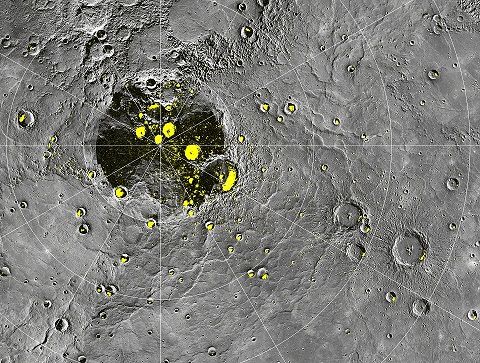
On March 21, 2012, the MESSENGER team also revealed new supporting evidence that many permanently shadowed craters in Mercury's polar regions may harbor water ice insulated with a thin layer of soil or dust, or some other radar-reflecting volatile substance such as sulfur. Such dark craters could have functioned as "cold traps," as new spacecraft imagery found that bright patches previously detected by ground-based radio telescopes (such as the Arecibo Observatory) in the 1990s are aligned precisely with shadowed areas of Mercury's craters (NASA MESSENGER image release; Chabot et al, 2012; Paul Rincon, BBC News, March 22, 2012; and Harmon et al, 2011).
 MESSENGER;
Harmon et al, 2011;
MESSENGER;
Harmon et al, 2011;
JHU.
CWRU.
NASA
Larger and
jumbo composite images.
Mercury's north polar region has
radar-bright spots in cold craters
sheltered from sunlight which may
to harbor water ice (more).
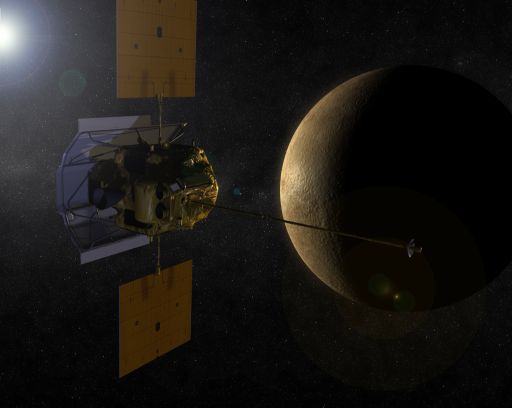
On March 29, 2011, NASA's MESSENGER spacecraft began sending its first close-up images of planet Mercury from orbit (MESSENGER news release and feature release; and Kenneth Chang, New York Times, March 30, 2011). After three flybys, MESSENGER inserted itself into orbit around Sol's innermost planet beginning March 18, 2011, at 12:35 AM UTC (March 17, 2011, at 8:35 PM EDT). No images was send back initially because many instruments were turned off for about a week to protect them from heat damage by the fierce sunlight that irradiates the planet and is re-radiated back out from its surface. The probe settled into an elongated, 12-hour orbit around Mercury that approaches within some 200 kilometers (120 miles) of its surface at the closest point and 15,000 km (around 9,300 miles) at the farthest. The orbit is also moving MESSENGER very close over the planet's north pole, where it will try to detect ice in craters shaded from the Sun which has been suggested by ground-based radar observations. The spacecraft will begin regular observations April 4, 2011 by using seven instruments to investigate the composition of the planet's surface, measure its topology, and mesure the planet's magnetic field (NASA Science News; and Maggie McKee, New Scientist, March 16, 2011).
 MESSENGER,
JHU/APL,
CIW,
NASA
MESSENGER,
JHU/APL,
CIW,
NASA
Larger and
jumbo images.
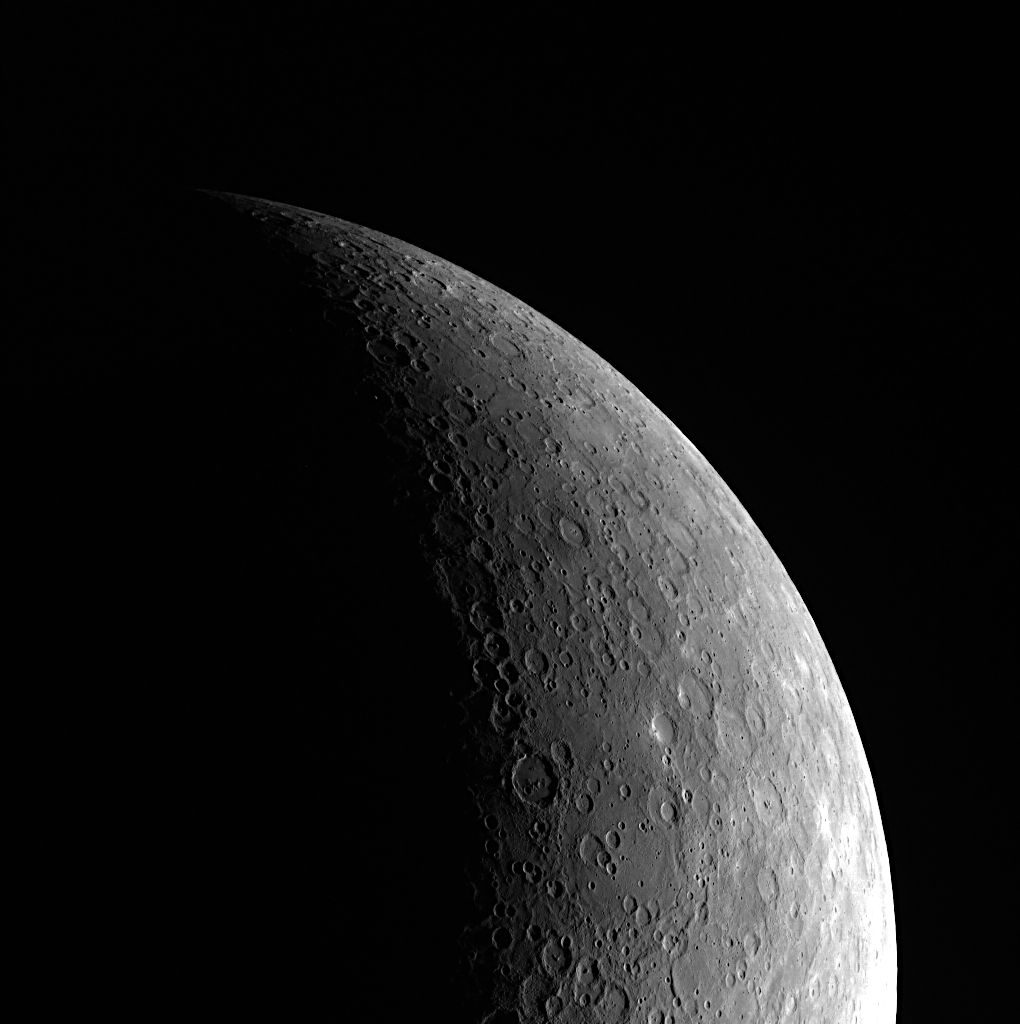
NASA's MESSENGER imaged Mercury
in crescent exposure by sunlight, as it
orbited Sol's innermost planet on May
2, 2011
(more).
To maintain Mercury's tight inner orbit around the Sun, the planet must move much faster than Earth needs to in its more distant Solar orbit so that a spacecraft must gain about 65,000 miles per hour (105,000 km per hour) to "catch" it. Due to fuel and propulsion restrictions, however, MESSENGER is relying on a complicated trajectory which required several gravitational assists from Venus as well as Mercury in its attempt to become the first Human spacecraft to orbit the planet. Shortly after the first flyby, NASA estimated that MESSENGER broke the known speed record for all spacecraft thus far by achieving a speed of over 140,000 miles per hour (over 225,300 km per hour). The new record is some eight times faster than the speed of NASA's Space Shuttle in low-Earth orbit (more).
 MESSENGER,
JHU/APL,
CIW,
NASA
MESSENGER,
JHU/APL,
CIW,
NASA
Larger and
jumbo illustrations.
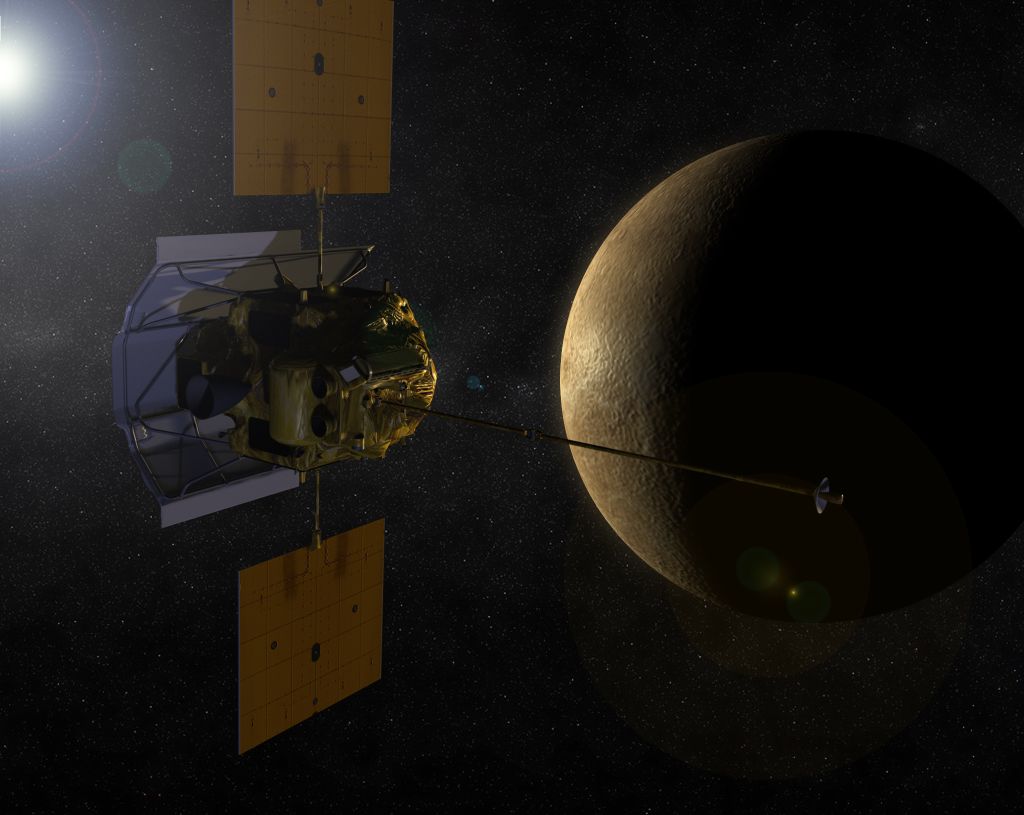
NASA's MESSENGER spacecraft
inserted itself into orbit around
Mercury on March 17, 2011, late in
U.S. mainland time zones
(more).
The Planet
 MESSENGER,
JHU/APL,
CIW,
NASA
MESSENGER,
JHU/APL,
CIW,
NASA
Larger and
jumbo images
(source).
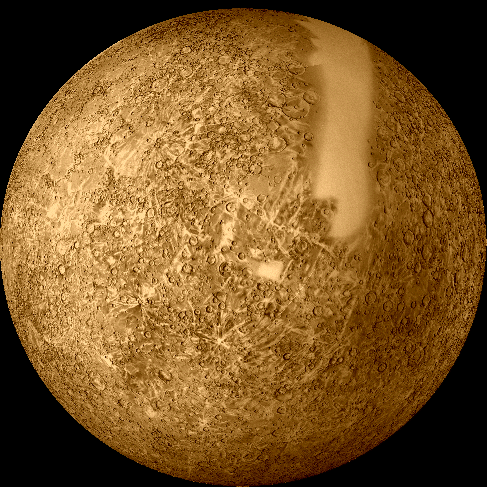
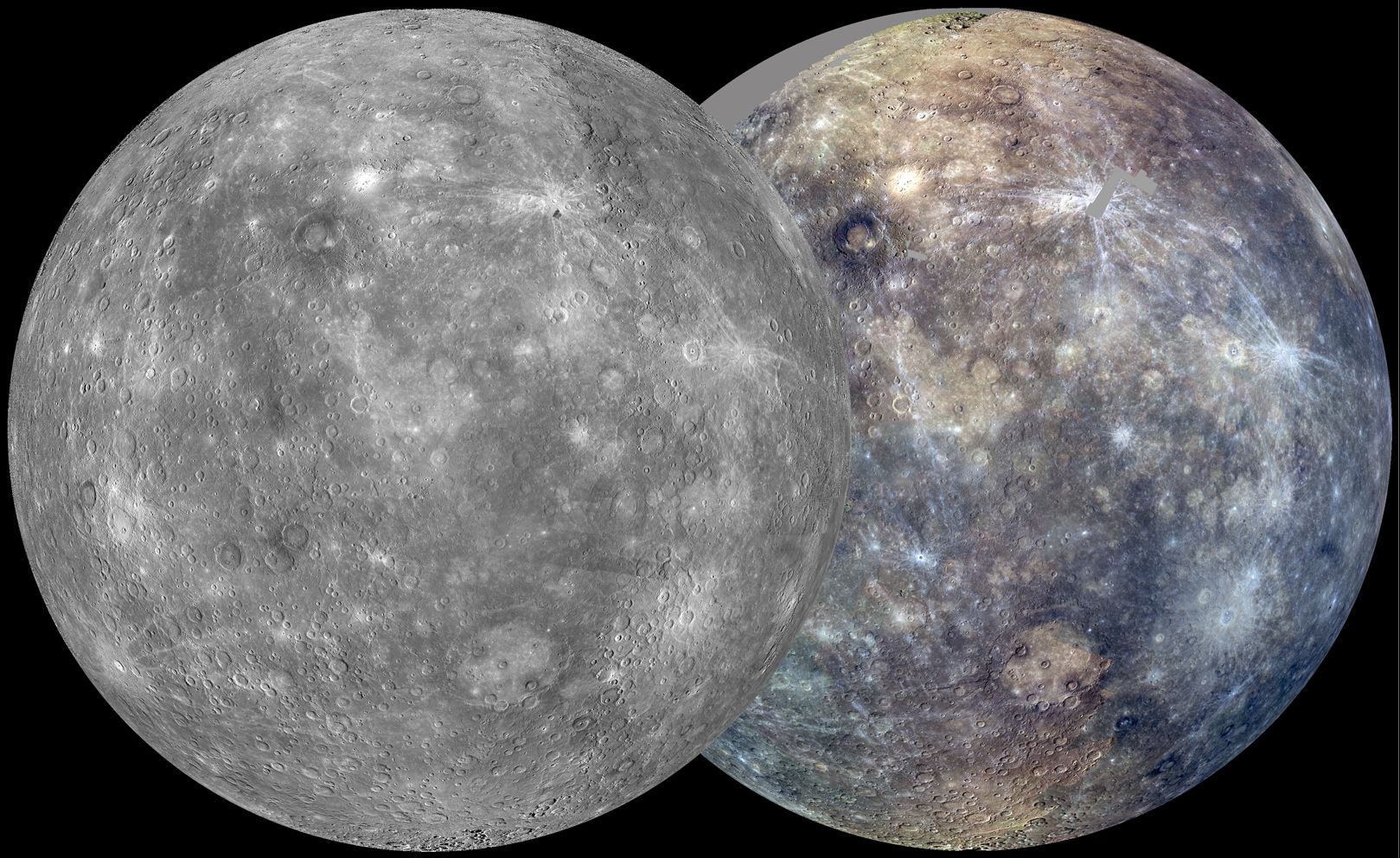
NASA's MESSENGER spacecraft
inserted itself into orbit around
Mercury on March 17, 2011 and
had assembled enough images for
a near complete map of the entire
surface, with color on the left but
black and white on the right
(more).
Located at only about four tenths of the Earth-Sun distance from Sol, Mercury is the closest planet to the Sun and the second smallest planet. (See an animation of Mercury's orbit around the Sun, with a table of basic orbital and physical characteristics.) Its diameter of 4,880 kilometers (about 3,033 miles) is about 40 percent smaller than Earth's diameter (smaller even than Jupiter's biggest moon Ganymede and Saturn's biggest moon Titan) but also roughly 40 percent larger than Earth's Moon. However, Mercury has only about six percent of Earth's mass.
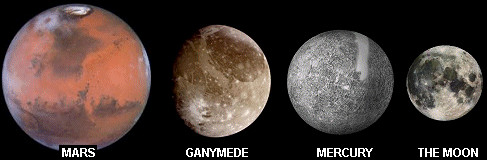
NASA (Mercury is smaller than Mars and Jupiter's moon
Ganymede, but larger than Earth's Moon)
The closest planet has a very elliptical (or eccentric) orbit and swings from only 46 million km (29 million miles) from the Sun at perihelion out to 70 million km (43.5 million miles) at aphelion. Mercury's orbit around Sol takes only about a fourth of an Earth year (about 88 days) to complete. However, it's daily rotation is much slower than Earth's and takes 59 Earth days to complete.
Because of its small mass and closeness to the Sun, Mercury isn't able
to hold on to much of an atmosphere. As a result, temperature
variations on Mercury are the most extreme in the Solar System ranging
from -183°C (-298 °F) to 427 °C (800 °F), although its average
surface temperature is 167 °C (333 °F). In contrast, the average
surface temperature on Venus is actually hotter
at a very stable 464 °C (867 °F) because of its thick atmosphere.
Mercury has a very thin atmosphere consisting of surface atoms
blasted off its surface by the Solar wind. Because Mercury is so hot,
however, these atoms quickly escape into space. Thus, in contrast to
the Earth and Venus whose atmospheres are stable, Mercury's atmosphere
is constantly being replenished.
Courtesy Jet Propulsion Laboratory. Copyright (c) California
Institute of Technology, Pasadena, CA. All rights reserved.
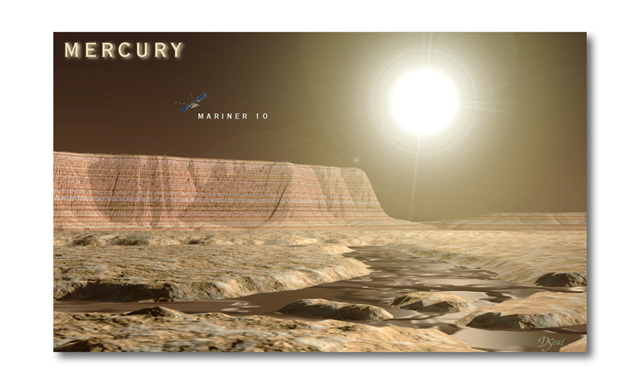
From Mercury, the Sun appears two and a half times larger than it does on Earth. The sky would appear black because there's little atmospheric scattering of light. However, one would be able to see two bright "stars," possibly discernible as cream-colored Venus and blue-colored Earth. Although Mercury is not tidally locked to the Sun, its rotational period of almost 59 days is tidally coupled to its orbital period of 88 days, rotating only one and a half times during each orbit in a 3:2 resonance. Hence, a "day" on Mercury (sunrise to sunrise) is 176 Earth days long.
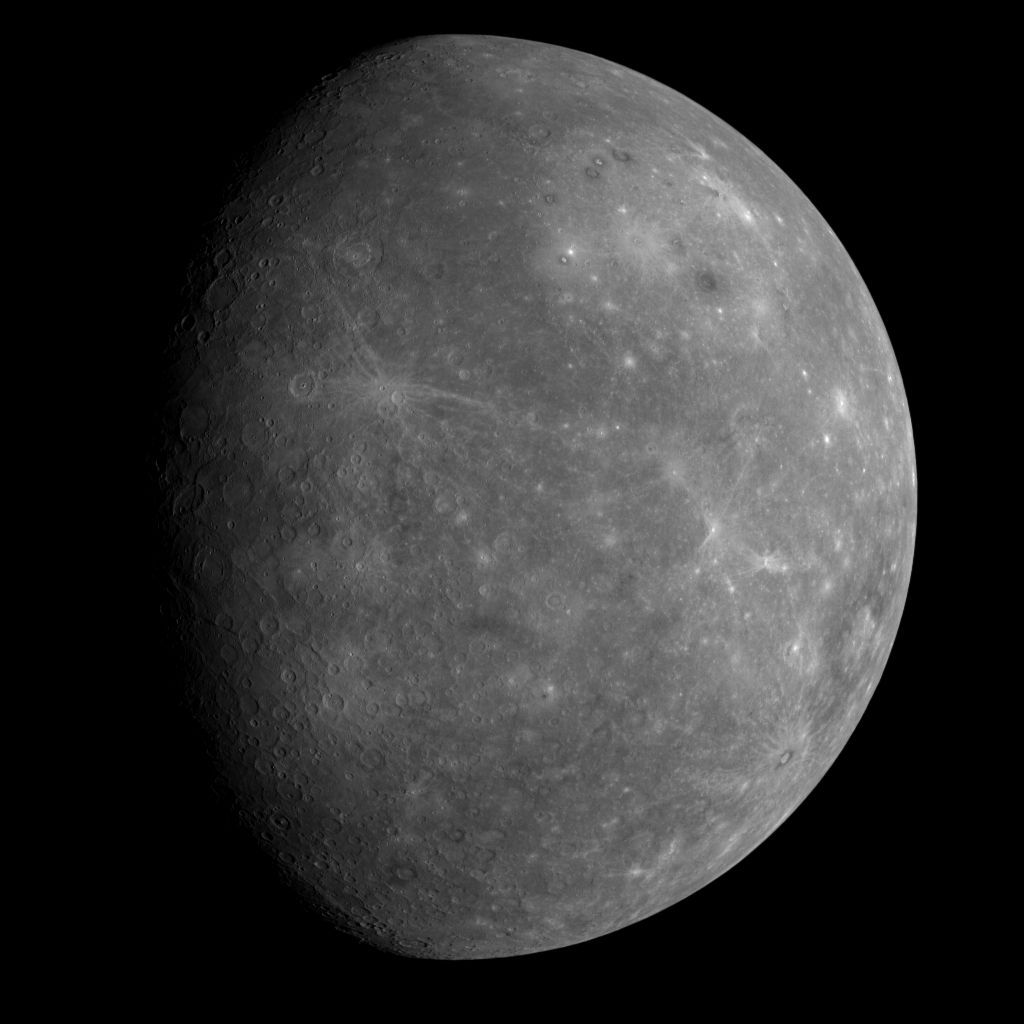
On January 14, 2008, NASA's MESSENGER spacecraft made its first "flyby" of Mercury, providing the first close-up view of the planet in 33 years (more from MESSENGER and APOD). MESSENGER passed about 124 miles (200 kilometers, or km) above Mercury's night-side surface, which appeared to be heavily cratered. The night-side view included the giant Caloris Basin, including previously unseen western portions. Formed by the impact of a large asteroid or comet, Caloris is one of the largest, and possibly one of the youngest, basins in the Solar System. NASA's new image of the complete basin interior reveals that it is brighter than surrounding regions, suggesting a different composition. Darker smooth plains completely surround Caloris, and unusually dark-rimmed craters are seen inside the basin.
 MESSENGER
JHU/APL,
CIW,
NASA
MESSENGER
JHU/APL,
CIW,
NASA
Larger and
jumbo images.
This red-light sensitive photograph
provides the first view ever of
Mercury's "backside" from a distance
of 27,000 miles or 27,000 kilometers,
which reveals the full extent of the
Caloris Basin
(more).
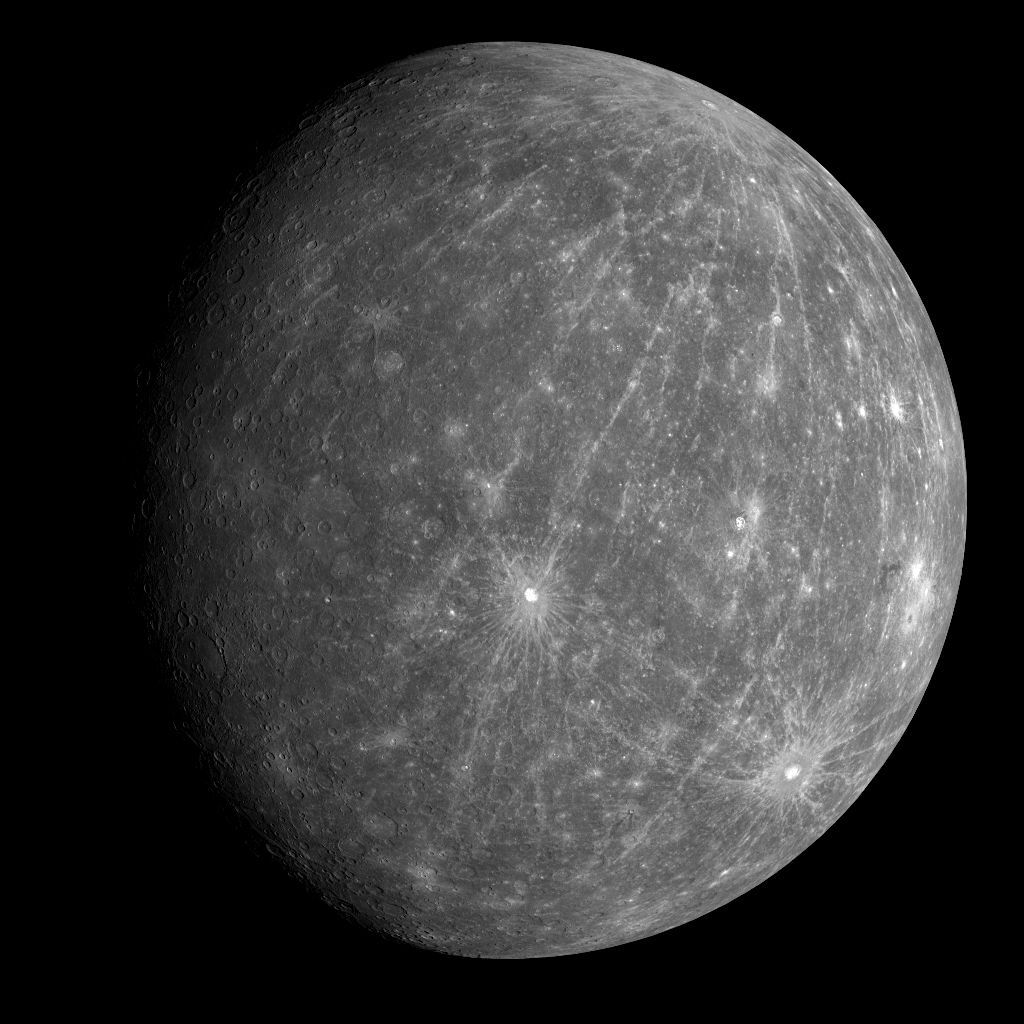
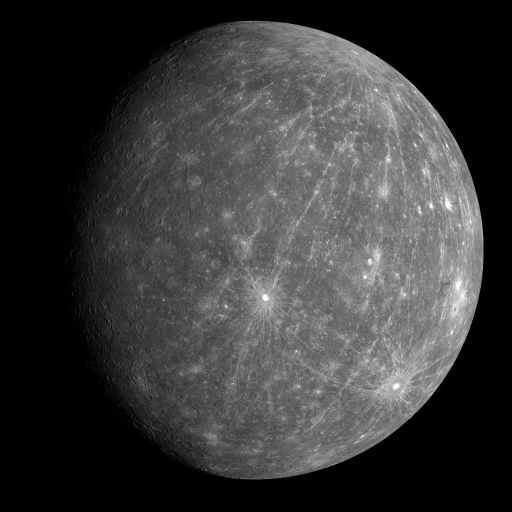
On October 6, 2008, NASA's MESSENGER spacecraft made its second of three flybys around Mercury, to be undertaken before it settles into orbit around the innermost planet in March 2011. New images were taken, including a global view centered on relatively bright Kuiper Crater, previously identified on images from the Mariner 10 mission (during planetary "encounters" between March 1974 and March 1975. Extensive "rays" of impact debris were seen to emanate from two other bright and apparently young craters, with at least one newly imaged by MESSENGER (more discussion and images from MESSENGER's second flyby on October 6, 2008).
 MESSENGER
JHU/APL,
CIW,
NASA
MESSENGER
JHU/APL,
CIW,
NASA
Larger and
jumbo images.
This red-light sensitive photograph
provides the first high definition
view of a region of Mercury centered
near Kuiper Crater that includes a
couple of relatively young, extensively
rayed craters
(more).
Although Mercury has no known satellites, the planet is similar to Earth's Moon because its surface is heavily cratered and very old, and there is no evidence of plate tectonics. Despite the predominance of cratered areas called "uplands," there are also regions of relatively smooth plains. Some may be the result of ancient volcanic activity but others may be made of debris from meteoric impacts. There is also some unconfirmed evidence of recent volcanism on Mercury, and radar observations of Mercury's north pole show evidence of water ice in the protected shadows of some craters. Unlike the Moon, the surface of Mercury has a slightly pinkish cast, and the planet is much denser than the Moon (5.3 versus 3.3 gm/cm3). Based on its high metal content and excluding the effects of gravitational compression, Mercury is the densest major planetary body in the Solar System, with about 1.2 times the uncompressed density of the Earth which averages 4.4 gm/cm3 (Murchie et al, Scientific American, March 2011). Accounting for gravitational compression, however, Mercury is the second densest after Earth, with 98 percent of its "mean" or compressed density (5.43 versus 5.52 gm/cm3, see NASA Planetary Factsheet).
 NASA/JPL/Northwestern
University
NASA/JPL/Northwestern
University
Larger image of
Mercury's surface.
This color composite of the terrain around Crater Kuiper at
lower right highlights differences in opaque minerals such as
ilmenite,
iron content, and soil maturity
(more).
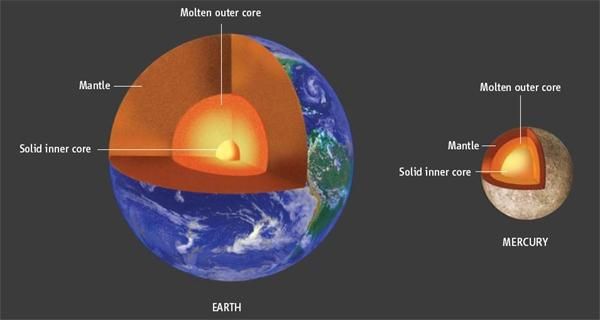
Unlike Earth, Mercury has only a relatively thin silicate mantle and crust, only 500 to 600 km (311 to 373 miles) thick. Inside, however, there is a large iron core whose diameter is 3,600 to 3,800 km (about 2,200 to 2,400 miles). Part of the core is probably molten, but Mercury's weak magnetic field is only one percent of the strength of Earth's. Some astronomers suggest that Mercury lost much of its lighter rocks to the Sun in early catastrophic impacts. Moreover, iron has not been detected on the surface, and so given its presumably large iron core, Mercury may be much more thoroughly differentiated than the other terrestrial planets.
 JHUAPL,
NASA
JHUAPL,
NASA
Larger illustration.
New observations provide
further evidence that
Mercury's core is
partially molten
(more).
On May 3, 2007, team of astronomers (including Jean-Luc Margot; Stan Peale; Igor V. Holin; Raymond F. Jurgens; and Martin A. Slade) announced new evidence that Mercury has a partially molten core using new observations of fluctuations in Mercury's spin obtained with radar signals bounced off the planet from Earth (with the 305-meter Arecibo, the 34-meter Goldstone, and the 100-meter Robert C. Byrd Green Bank radio telescopes). They deduce that the planet has a solid inner core surrounded by a relatively thin, molten outer core, which is possible if the core contains some sulphur as well as iron. In order for Mercury's core to have stayed molten over some 4.5 billions of years since the planet first formed from agglomerating planetisimals, however, its mostly iron core must also contain a lighter element, such as sulfur, to lower the melting temperature of the core material. If Mercury does contain some sulphur, it must have come from planetesimals that formed further out from the Sun since sulphur could not have condensed out of the early Solar nebula through the circum-Solar dust disk so close to the Sun. Beginning in 2011, NASA's MESSENGER mission will provide additional observations that can produce a more definitive understanding of the planet's core (more from NASA's news release and Cornell's press release).
 MESSENGER,
U. Colorado,
MESSENGER,
U. Colorado,
JHU/APL,
CIW,
NASA
Larger illustration.
Depiction of a simulated
magnetosphere illustrates
how Mercury's magnetic
field lines (blue) are
distorted by the Solar
Wind
(more).
During its January 2008 flyby, NASA's MESSENGER spacecraft detected an internal magnetic field consistent with the field from a dipole nearly aligned with the planet’s spin axis (with a dipole tilt around 10°). The MESSENGER observations and data from the two earlier Mariner 10 flybys are consistent enough to describe a dipolar field with an active electrical dynamo in which the magnetic field is produced by electrical currents flowing in an outer core of molten metal (more discussion and images from MESSENGER's January 2008 flyby). More discussion about the magnetic field and Mercury's hypothesized molten or partially molten core can be found below.
Other Information
More images of Mercury are available at NASA's Planetary Photojournal. A fact sheet on Mercury is also available from NASA's National Space Science Data Center.
David Seal (a mission planner and engineer at NASA's Jet Propulsion Laboratory at CalTech) has a web site that generates simulated images of the Sun, planets, and major moons from different perspectives and at different times of the year. Try his Solar System Simulator.
For more information about the Solar System, go to William A. Arnett's website on "The Nine Planets", or to Calvin J. Hamilton's web page on "Mercury".
© 1998-2012 Sol Company. All Rights Reserved. |